Ted Moore
Neither the Birth nor Death of a Walnut Tree
Ink painting on panel, walnut, acrylic, gold leaf, copper leaf, brass, 18”h x 10”w x 3”d, Item No. 23914,
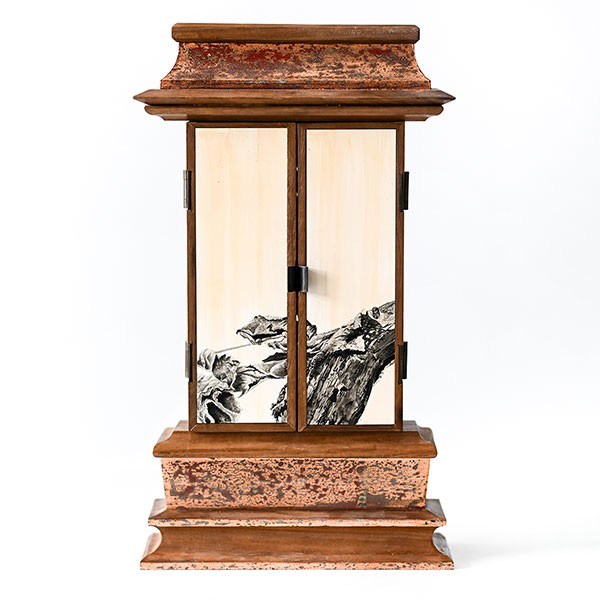
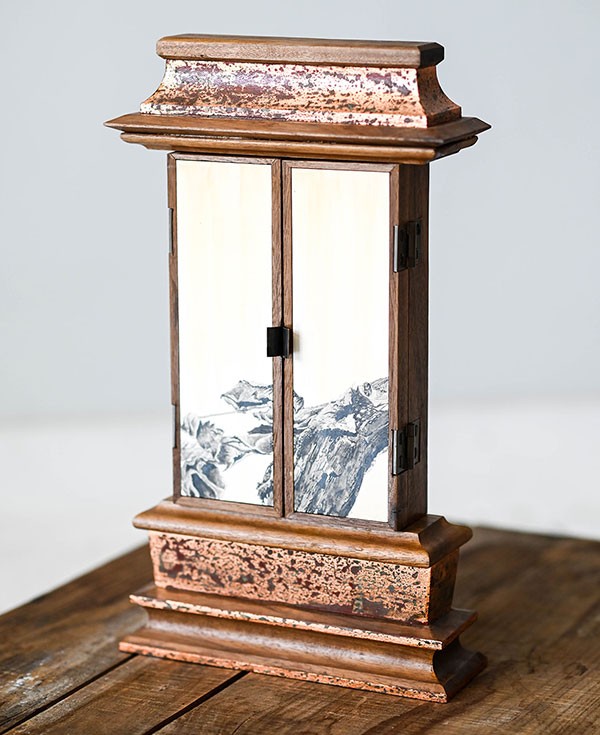
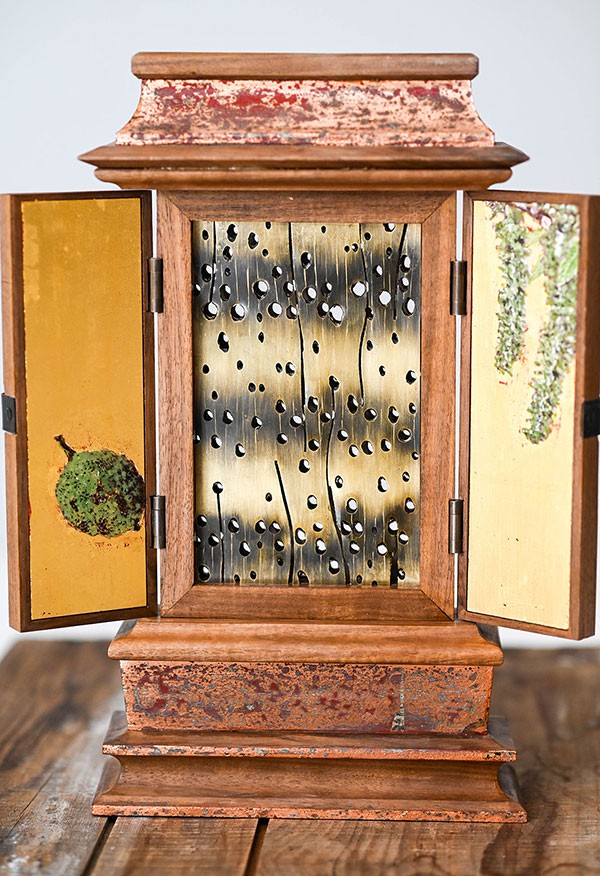
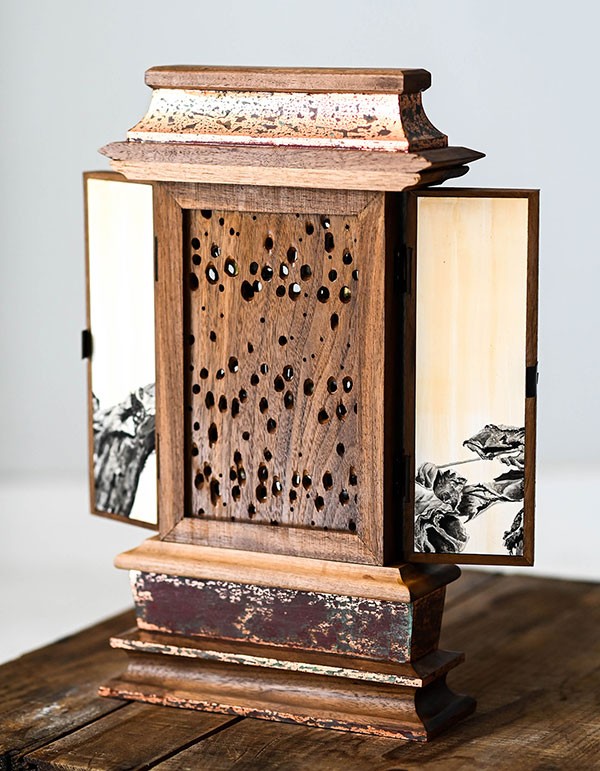
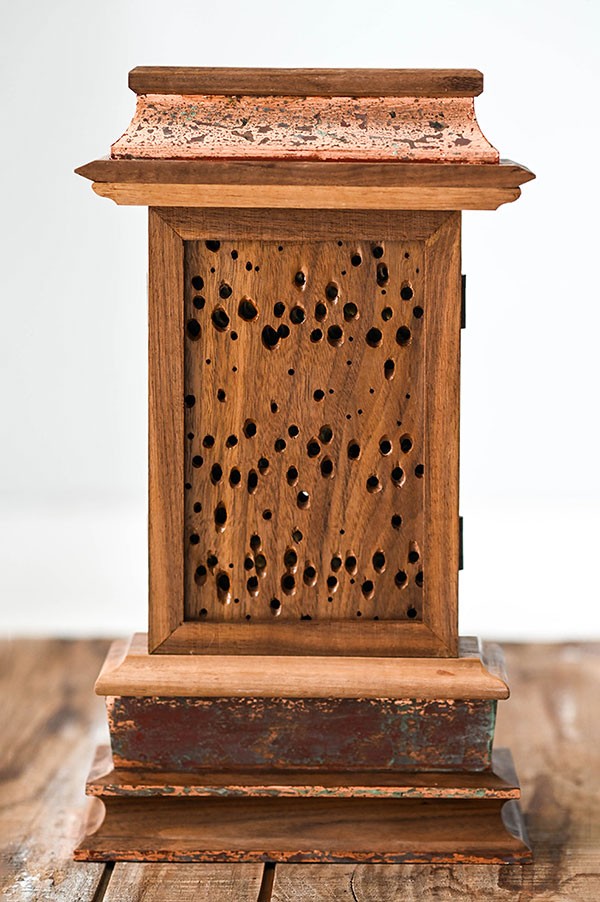
This is a small devotional triptych. Its size and structure are drawn from a "House Altarpiece" from Germany (c.1490) at the Met Cloisters in NYC that I saw. After completing Walnut Remembering Cottonwood I wanted to make a smaller, freestanding triptych. In this case, I also wanted to apply all that I learned concerning the aesthetics and visual mechanics of late medieval triptychs: the hierarchy of materials and coloration, the concern with liminality, and the attempt to capture visually and materially a transcendent moment. To focus these efforts, this piece concerns walnut entirely -- as material, as image, as metaphor. The exterior of the triptych consists of a greyscale (i.e. grisaille) painting of decaying walnut along with copper leaf. The use greyscale, the theme of decay and death, and the use of a tarnishable metal such as copper are hierarchically appropriate to the exterior. The interior doors consist of gold leaf surrounding paintings in color of (on the left) the female fruit and (on the right) the male catkin or flower.
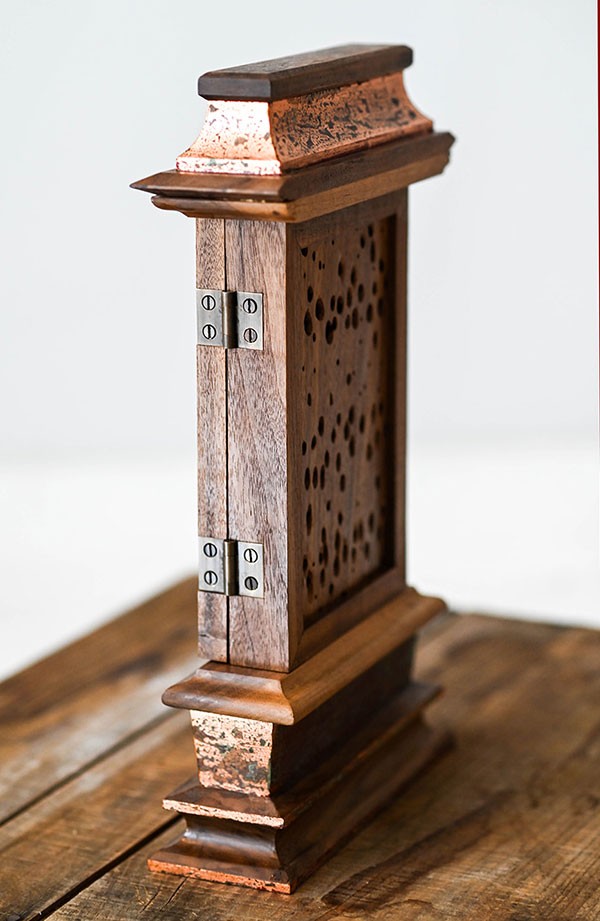
(Note: walnut trees are monecious, having both male and female reproductive organs.) The center piece is a plate of brass that I sculpted to represent what the end grain of walnut appears like under a microscope. I alternately polished and tarnished the brass to suggest early and late wood. With corresponding "holes" in the back panel, the intention is for light to pass through from back and to catch the viewers attention when the triptych is open. This is the moment of transcendence or, in historically religious terms, transubstantiation -- “that point at which something comes to be seen for what it really is, despite appearance.”
Walnut as material, image, and metaphor reveals commonality and interconnection of being itself. Like all my "devotional" pieces, this triptych is not so much a devotion to walnut, but rather a devotion to what walnut (as all things, all objects) might teach us about the nature of being. The ideal positioning of this triptych would be backlit by a window facing West. The title is taken from Rumi's poem "Bowls of Food" in which the poet explores the spiritual lessons of flora and fauna.